Recently listened to a lecture on regenerative electric flight. Electric motor and propeller airplanes are actually flying these days in 2011. Electric motor glider can take off using electric motor and propeller, and fly into an area of lift there to circle and gain altitude in the regular way as a glider flies. During glide to landing, the propeller could function as a windmill and the motor could function as a generator, recharging the batteries during descent.
More after the cut.
Showing posts with label hobbies science experiment. Show all posts
Showing posts with label hobbies science experiment. Show all posts
Tuesday, April 26, 2011
Monday, January 31, 2011
My Quarks
Electron quarks may exist. If protons are made of three proton quarks, then perhaps electrons are made of three electron quarks. Symmetry considerations would seem to indicate that the electron might have an internal structure similar to the internal structure of a proton. We are asked to believe that neutrons have mass from three quarks and no electric charge. We are asked to believe that protons have mass from three quarks plus electric charge from three quarks. In this same vein, due to symmetry considerations, perhaps electrons have the charge of minus three electron quarks. At any rate it seems that electrons have some type of internal structure as shown in this blowtorch experiment. Click the link to skip over this whimsical post.
Previous attempts to show that electrons have no temperature, and little or no specific heat, have been studying the relationship between an electron and the atom nucleus. Very little consideration was given to the idea that an electron might have specific heat and temperature related to it's own internal structure. Free electrons, or conduction electrons populating an electric conductor inside of solid metal, do not associate with any one single atom nucleus. Therefore the temperature and specific heat of free electrons must be independent of any other relationship of the electron with something else.
In the circuit diagram shown, the silicon NPN transistor is acting as a blowtorch heating up the electron current as it flows through the transistor. An improved circuit has a thermalizing junction. Hot electrons from the silicon NPN transistor will run through a short length of copper wire and then appear in the thermalizing junction that "Diode B" represents. The silicon "Diode B" will conduct this heat from the hot electrons into a heat sink. The heat will go right in to the solid silicon. In this case the "Diode B" doesn't add any heat, and a lot of the heat energy can flow out of the electron and into the thermalizing junction.
As a result the next transistor which is a PNP transistor, will catch a load of room-temperature electrons, rather than hot electrons. The addition of "Diode B" in this circuit eliminates a lot of those heating effects in the next transistor and as a result the PNP transistor becomes quite reliable.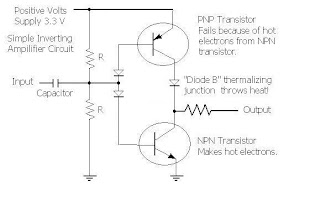
fin.
Previous attempts to show that electrons have no temperature, and little or no specific heat, have been studying the relationship between an electron and the atom nucleus. Very little consideration was given to the idea that an electron might have specific heat and temperature related to it's own internal structure. Free electrons, or conduction electrons populating an electric conductor inside of solid metal, do not associate with any one single atom nucleus. Therefore the temperature and specific heat of free electrons must be independent of any other relationship of the electron with something else.
In the circuit diagram shown, the silicon NPN transistor is acting as a blowtorch heating up the electron current as it flows through the transistor. An improved circuit has a thermalizing junction. Hot electrons from the silicon NPN transistor will run through a short length of copper wire and then appear in the thermalizing junction that "Diode B" represents. The silicon "Diode B" will conduct this heat from the hot electrons into a heat sink. The heat will go right in to the solid silicon. In this case the "Diode B" doesn't add any heat, and a lot of the heat energy can flow out of the electron and into the thermalizing junction.
As a result the next transistor which is a PNP transistor, will catch a load of room-temperature electrons, rather than hot electrons. The addition of "Diode B" in this circuit eliminates a lot of those heating effects in the next transistor and as a result the PNP transistor becomes quite reliable.

fin.
Thursday, January 27, 2011
My Blowtorch Experiment
A classic science experiment requires the student to determine the direction of electric current flow in a metal wire. A professor will attach a battery to a loop of wire, then the student will attempt to determine which way the battery plus and minus are connected to the wire. The student isn’t allowed to see the battery, which is hidden. The student is provided with nothing. Here is a novel way to find out which way the electricity is flowing through the metal wire.
 The student will request or bring a blowtorch, a spark igniter, and two different flavors of perfume. This example uses vanilla and peppermint perfumes. Vanilla perfume is placed toward the right end of the bare wire, peppermint perfume is placed toward the left end of the bare wire, then the perfume bottles are removed from the room. As the bare wire is cold, there isn’t much odor from the perfumes.
 The next step is a heat hazard, so be careful or ask a grownup for assistance. Start the blowtorch with the spark igniter and heat up the center of the bare wire until it glows cherry red. The temperature distribution in the wire will be a bell shaped curve
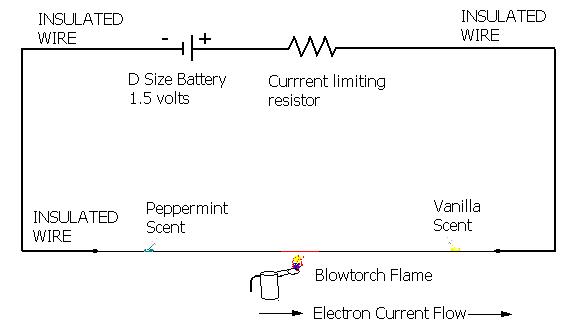 Bell Shaped Curve showing temperature distribution in the bare wire while the electric current is zero.
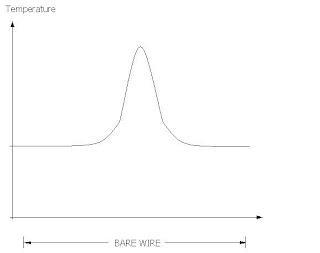
Next, the professor will attach a D battery (1.5 volts) to the loop of wire. As the charge carriers (electrons) move from the battery minus to battery plus, through the bare wire, those electrons will heat up while passing through the cherry red portion of the bare wire. The resulting hot electrons will heat up one end of the bare wire, and one of the two odors will evaporate from the bare wire. There will be a skewed temperature distribution.
 Because of the odor, either peppermint or vanilla in this case, the student will be able to know which way the electric current is flowing through the wire. Hence the student will be able to tell the professor which way the D battery is connected to the loop of wire. A strong scent of vanilla will indicate that the electrons are traveling from left to right through the bare wire. The professor will probably accept this as a valid proof and declare the student’s experiment to be a success.
An existing tradition is a belief that electrons don’t contribute to specific heat of a solid. Such as this reference for example. The idea that electrons don’t have temperature or specific heat was a simplifying assumption that was made by scientists such as Navier and Stokes who didn’t have computers, they did everything with pencil and paper. The blowtorch experiment shows that electrons can and do carry significant amounts of heat (or cold) because electric current involves a lot of electrons, perhaps Avogodro’s number of electrons, passing by each point in in the wire every minute.
Since electrons have temperature, and since transistors are hot when running, it is possible to surmise that the NPN transistor on this diagram will make those conduction electrons hot, and then those hot electrons will pass through the PNP transistor. This contributes to premature failure of PNP transistors in actual circuits. The specific mechanism of this PNP transistor failure will be a subject of subsequent reading in this space.
 Maybe someday there will be a positronic conducting wire, that is a wire (possibly made of antimatter) that will have positrons rather than electrons conducting electric current. This blowtorch experiment provides a method of searching for such a positronic conductor because the resulting temperature would become skewed in the opposite direction.
 It is more likely that a positronic conductor would be made of plasma rather than existing as a room temperature solid. Although a room-temperature conductor of positrons hasn't been found as of yet, we should not assume that there isn’t or can’t be a positronic conductor, although such an item seems to be unlikely based on experience.
As an aside, positive conducting P type semiconductors use "positively charged hole" conduction which implies that electrons are actually traveling in the opposite direction of the hole current . It is unlikely that hole conduction would show a positronic temperature profile during the blowtorch experiment. Holes don't have any specific heat.
Be sure to allow the wire to cool off between experiments. Or, put ice in the middle of the wire and observe drift electron cooling effects as electrons become cold by passing through the cold section of the bare wire.

Next, the professor will attach a D battery (1.5 volts) to the loop of wire. As the charge carriers (electrons) move from the battery minus to battery plus, through the bare wire, those electrons will heat up while passing through the cherry red portion of the bare wire. The resulting hot electrons will heat up one end of the bare wire, and one of the two odors will evaporate from the bare wire. There will be a skewed temperature distribution.
An existing tradition is a belief that electrons don’t contribute to specific heat of a solid. Such as this reference for example. The idea that electrons don’t have temperature or specific heat was a simplifying assumption that was made by scientists such as Navier and Stokes who didn’t have computers, they did everything with pencil and paper. The blowtorch experiment shows that electrons can and do carry significant amounts of heat (or cold) because electric current involves a lot of electrons, perhaps Avogodro’s number of electrons, passing by each point in in the wire every minute.
Since electrons have temperature, and since transistors are hot when running, it is possible to surmise that the NPN transistor on this diagram will make those conduction electrons hot, and then those hot electrons will pass through the PNP transistor. This contributes to premature failure of PNP transistors in actual circuits. The specific mechanism of this PNP transistor failure will be a subject of subsequent reading in this space.

As an aside, positive conducting P type semiconductors use "positively charged hole" conduction which implies that electrons are actually traveling in the opposite direction of the hole current . It is unlikely that hole conduction would show a positronic temperature profile during the blowtorch experiment. Holes don't have any specific heat.
Be sure to allow the wire to cool off between experiments. Or, put ice in the middle of the wire and observe drift electron cooling effects as electrons become cold by passing through the cold section of the bare wire.
Subscribe to:
Posts (Atom)